

For decades, major fashion brands have been battling counterfeiters. However, in the cycling world, fake products often find their way into the hands of unsuspecting consumers who believe they’ve stumbled upon a great deal—never suspecting that anyone would bother faking bicycle components.
Yet, counterfeit parts are now rampant in cycling. It may have started with high-ticket items like Specialized S-Works or Pinarello Dogma frames, but today, fakes extend to nearly every popular or profitable product—from Rapha jerseys and Chris King headsets to Garbaruk chainrings, Ritchey handlebars, Park Tool workshop tools, Thomson seatposts, and POC helmets.
Every bicycle component is safety-critical, but we’ve grown increasingly concerned about how easily people may unknowingly purchase counterfeit brake rotors, Ultegra pedals, or even chains—parts where failure could be catastrophic. Yes, chains.
After the Global Cycling Network previously covered fake chains on YouTube, we wondered: beyond different packaging and finish, what are the functional differences? We reached out to Adam Kerin of Zero Friction Cycling to conduct controlled durability and strength testing. What we discovered was startling—even to us and to Adam—revealing just how poor and potentially dangerous these counterfeits can be.
While this test focused on one specific high-end chain model, we believe the findings are widely applicable.
Procurement
All major chain manufacturers are fighting counterfeits. We’ve seen fake chains branded as SRAM, KMC, YBN, and of course, Shimano. Among these, Shimano chains appear to be the most frequently copied, with the Dura-Ace/XTR-level 11-speed HG-901 chain being one of the most commonly purchased fakes.
In Australia, a genuine HG-901 retails between AU$55 and AU$110 (~¥258–318 RMB). To ensure authenticity, our control chain was purchased directly from Shimano Australia, a subsidiary of Shimano Japan.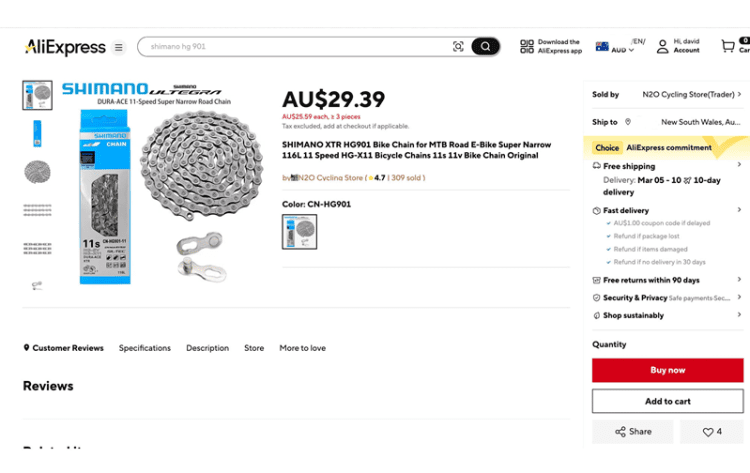
For the test, we didn’t want to buy obvious US$10 fakes from secondhand platforms. Instead, we sought out chains that could be mistaken for genuine. One fake was purchased via eBay for AU$62.69 (~¥300 RMB); another came from AliExpress for AU$29.39 (~¥144 RMB) from a seller claiming authenticity—even showing a Shimano anti-counterfeit label in photos. We considered ordering from Amazon, but import delays and near-double pricing made it impractical.
Packaging
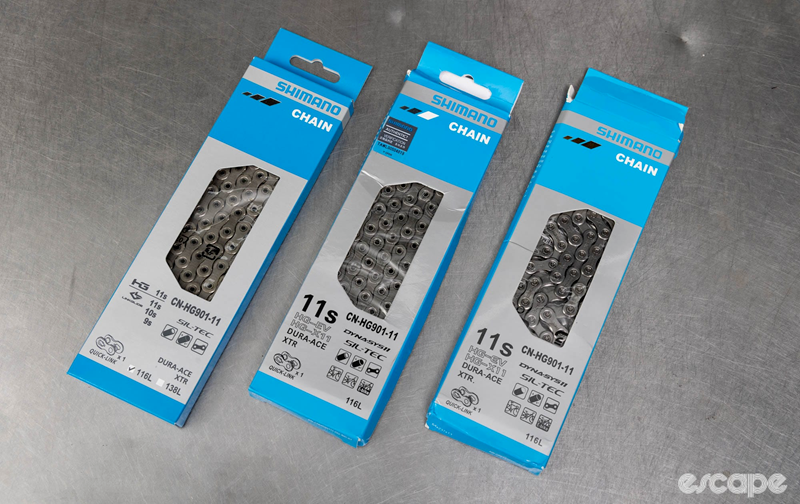
Early signs indicated the fakes. The AliExpress and eBay chains came in boxes with a glossier finish; one had split glue seams. A marker writes cleanly on genuine Shimano packaging but smudges on the fakes.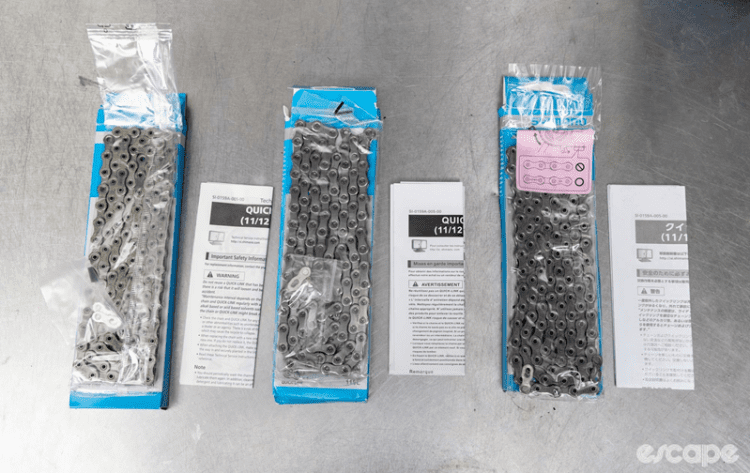
The eBay chain had a sticker and barcode purporting authenticity—an anti-counterfeit system Shimano uses in some Asian markets. Ironically, the genuine Australian-sold chain lacked this sticker. Meanwhile, the UPC barcode on the back was a sticker on the genuine box but printed directly on the fakes.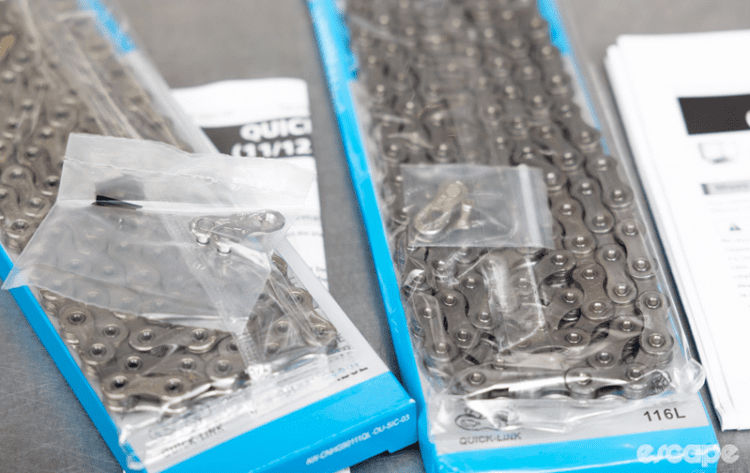
Inside, more differences emerged. The sealed plastic wrapping varied, but most notably, the genuine Shimano chain had its quick-link packaged separately, while both counterfeits included it loose in the bag.
Measurements
The Shimano HG-901 is a high-end 11-speed chain featuring consistent chrome plating and hollow pins. The eBay chain looked very close, but the AliExpress version had an obvious red flag: solid pins instead of hollow.
Dimensional differences also existed. The AliExpress chain was a crude imitation, while the eBay version was surprisingly close. Roller diameters measured 7.7 mm (AliExpress), 7.65 mm (eBay), and 7.65 mm (genuine). Chain width (measured at pin centers) showed the AliExpress chain was widest at 5.77 mm, versus 5.68 mm (eBay) and 5.67 mm (genuine).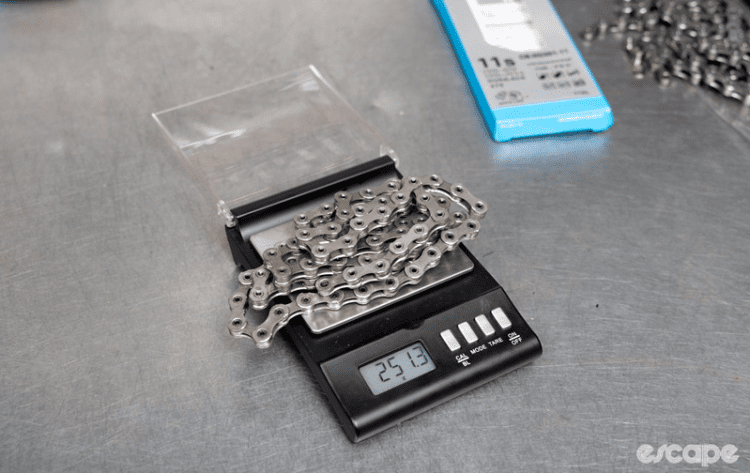
On the scale, the 116-link eBay chain weighed 245.2 g, the AliExpress chain 260.5 g, and the genuine HG-901 251.3 g.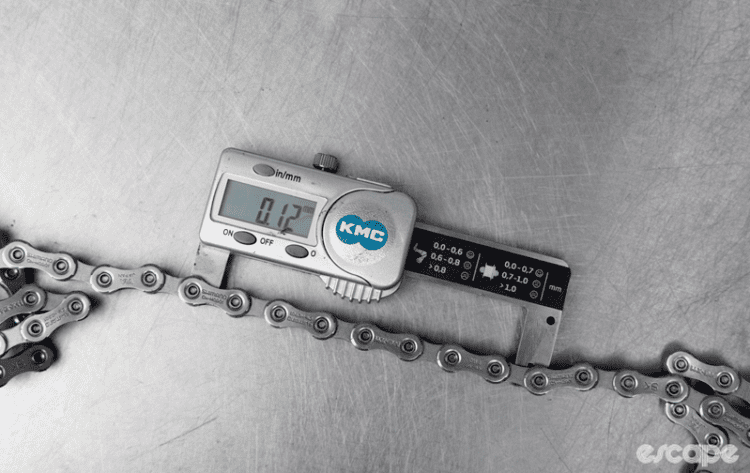
Differences appeared even before use. Chain wear occurs through use, but low-end chains often measure worn when new. Using a KMC digital chain checker, the genuine chain showed 0.00 mm wear—consistent for this model. The eBay chain measured 0.03 mm—close, but not perfect. The AliExpress chain was far worse at 0.12 mm wear (despite its larger rollers, which should have reduced the reading). That’s one-fifth of its total allowable wear—before it was even installed.
Durability Testing
To test chain durability, we turned to Kerin, who has built a business around chain wear testing to evaluate lubricant efficiency and running costs.
We’ve collaborated with Kerin on several projects, including original research correlating friction and wear tests for chain lubes, and identifying the most durable chains. This counterfeit test was smaller in scale but equally insightful.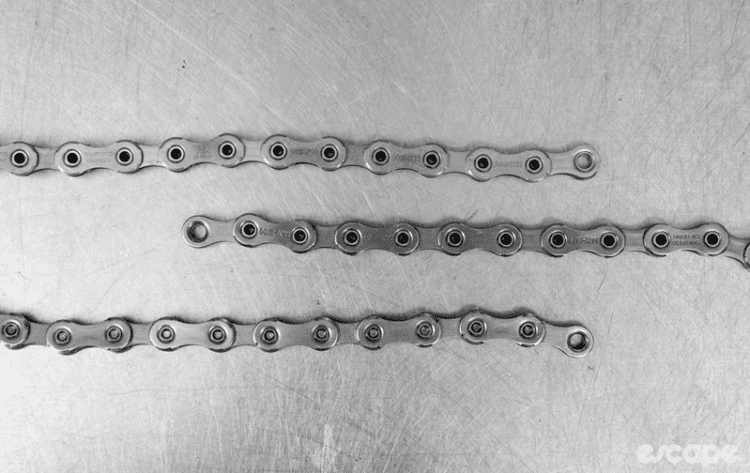
Kerin subjected the three chains to Zero Friction Cycling’s standard controlled test: a 250W motor driving a road drivetrain on an indoor trainer. The chains underwent a series of 1000 km segments designed to simulate real-world use. All chains were stripped to bare metal, then treated with Finish Line Dry lubricant—chosen for its popularity and its role as a wear accelerator to reduce test time. Chains were considered worn at 0.5% elongation.
The results clearly show that buying counterfeit chains is a false economy. Although sample sizes were small, the genuine HG-901 lasted at least three times longer than the fakes. Importantly, chain wear directly causes wear on chainrings and cassettes, multiplying the cost far beyond the chain itself.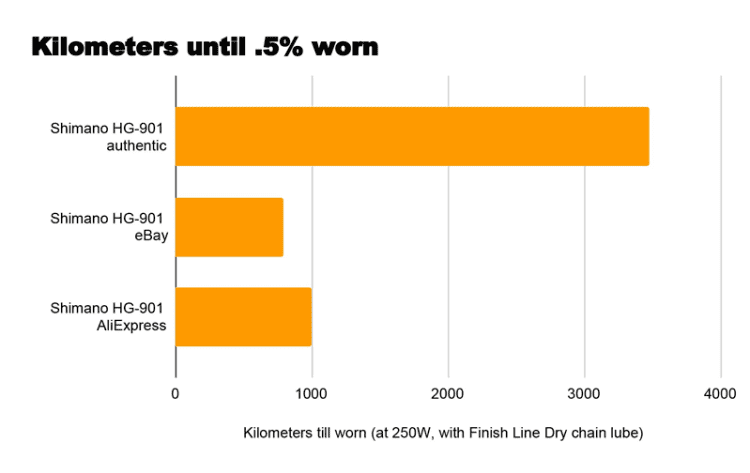
In the first 1000 km of clean testing, the counterfeit chains failed. The genuine chain proceeded into controlled grit-included test phases.
Both the eBay and AliExpress fakes now rank at the bottom of Zero Friction Cycling’s chain lube test rankings—below even an unlubricated genuine Ultegra chain. Yes, using counterfeit chains appears more damaging to your drivetrain than running genuine chains dry. For reference, previous controlled tests of Finish Line Dry on Ultegra 11-speed chains reached about 3200 km, consistent with data showing that Dura-Ace chains typically outlast Ultegra versions.
We didn’t expect the gap to be this stark. While any counterfeit will differ from the genuine article, this wasn’t just a difference of day and night—it was more like eclipse versus supernova. The counterfeits are utter junk.
Strength Testing
After all chains reached 0.5% elongation, they underwent strength testing. Zero Friction Cycling uses a fixture designed to test chain shear strength—originally assembled to help AusCycling (formerly Cycling Australia) test chains for Olympic track projects. The test involves a hydraulic ram pressing into a short chain loop until failure.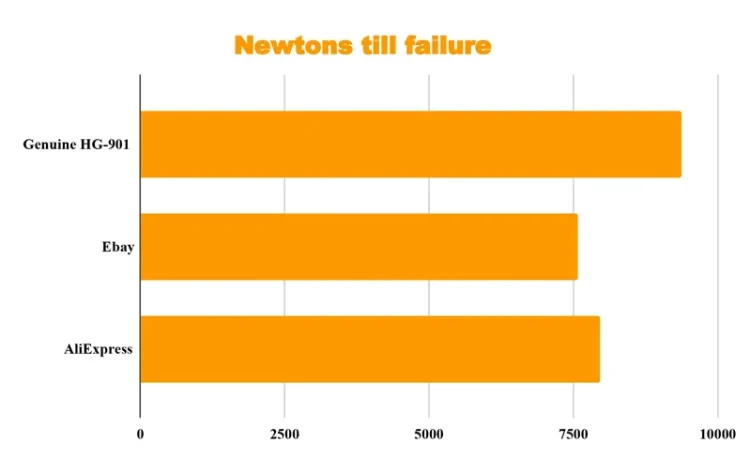
International standards (ISO) exist for chain tensile strength—chains are safety-critical components. As seen in testing, even worn, a genuine Shimano HG-901 exceeds ISO standards. The ISO requirement is 8000 Newtons; some markets adhere to a stricter European standard (EN) requiring 9200 N. Both counterfeit chains failed both standards.
Kerin also measured stretch deformation under load in 1000 N increments, and remeasured without load to assess material fatigue.
At 5000 N load, the genuine HG-901 showed no measurable deformation. The eBay chain fared worst with 0.38 mm stretch; the AliExpress chain stretched 0.11 mm. More worryingly, both counterfeits began deforming under much lighter loads. And all this after wear testing—with the genuine chain having endured about 3.5 times more test distance.
In short, counterfeit chains—no matter how close they look—are clearly made from inferior materials and/or omit crucial steps like heat treatment.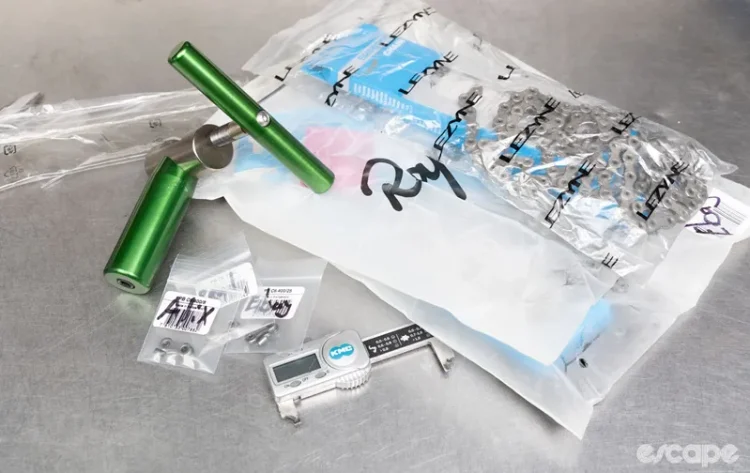
Kerin’s tensile test is a straightforward pull test; it doesn’t simulate extreme chain angles or shifting loads that typically cause chain failure. That said, we believe the performance gap would only widen under multi-directional load testing.
Even removing chain pins revealed huge differences in rivet quality. Using a chain tool on the genuine chain required significant force; the AliExpress chain (with solid pins) was alarmingly easy, and the eBay chain was somewhere in between.
Other Factors
If rapid wear, reduced strength, or the simple ethics of intellectual property theft aren’t enough to avoid counterfeit chains, there are other compromises.
Commonly reported downsides include increased noise and poor shifting performance. Moreover, counterfeit chains often lack the subtle profiling and shapes designed to optimally match the corresponding brand’s cassettes. Finally, loose tolerances in fake chains allow more lateral flex—a known detriment to shifting performance.
Some coatings and finishes used on counterfeit chains are also known to interact poorly with common lubricants. Some lube and wax manufacturers (including Silca) report reduced durability when their products are used with counterfeit chains. While results vary by lubricant and fake, this is another critical consideration.
Where You Buy Matters
This test involved only one chain model and a total of three samples, but we hope these findings encourage skepticism toward deals that seem too good to be true—whether for chains, rotors, or other components. Every bicycle part should be treated as safety-critical.
In most cases, counterfeit chains aren’t significantly cheaper than genuine ones. Sometimes, you may even pay a premium for uncertainty. Interestingly, six months after our purchases, both the eBay and AliExpress sellers we bought from no longer list these chains—a common pattern among fly-by-night vendors.
The modern e-commerce world isn’t always transparent, and it seems to be getting worse. While platforms like Amazon, eBay, and AliExpress do host legitimate sellers, they also harbor vast quantities of counterfeits. Additionally, watch out for fake online bike shops and brand storefronts.
Given the growing list of brands reporting copied parts, we recommend purchasing branded components only from known authorized dealers—or better yet, your local bike shop. On the rare occasion a shop sells fakes as genuine, you can report them to the brand.
While some knowingly buy fakes, many consumers are deceived. In either case, it’s a dangerous game when your safety depends on that part performing as intended. As always, if the price seems too good to be true, it probably is.


