Shimano has introduced a comprehensive evolution in braking performance with the new XTR M9220 four-piston brake set. Designed alongside the fully wireless XTR Di2 groupset, these brakes feature an entirely new structure and use a proprietary low-viscosity mineral oil, delivering significant improvements in ergonomics and consistency for more powerful and controlled stopping.
Unboxing the Official Package
The official retail package arrives in sustainable paper box packaging. Inside four individual boxes are the left and right brake levers, front and rear four-piston calipers, and a bottle of Shimano’s new pink, low-viscosity mineral oil, developed specifically for this new generation.
Key Fluid Update: Shimano Low-Viscosity Oil
This new hydraulic fluid is engineered to maintain stable braking performance across a wider temperature range. It is certified for use in the M9200, M9220, and M8200 levers and M9200, M9222, M8200, M8220, and MT805 calipers—essentially the brake systems within Shimano’s latest fully wireless mountain groupsets, XTR and DEORE XT.
Shimano explicitly warns against using this new oil in older brakes designed for standard mineral oil, as the internal seals are not compatible.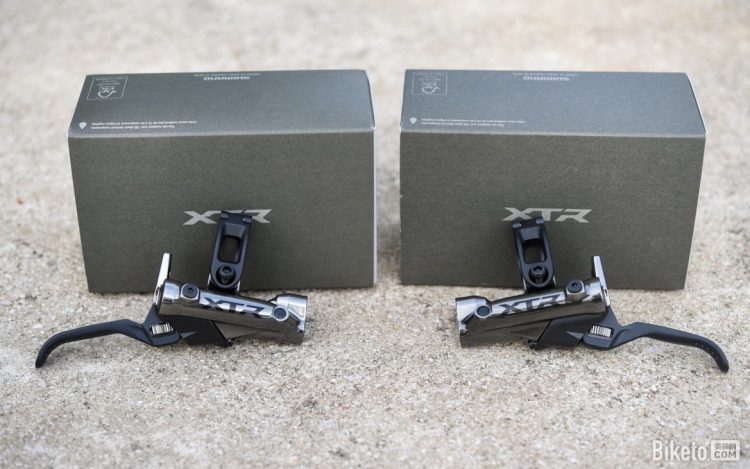
Lever Refinements and Ergonomic Upgrades

The XTR M9220 levers maintain the top-tier series’ classic black and silver color scheme but with a more angular design. The most notable update is the new Shimano ERGO FLOW technology, which positions the lever pivot closer to the handlebar. This alignment makes the lever follow the natural arc of your fingers when pulled.
Tool-free adjustment for the bite point (lever reach) remains, but the mechanism is now more refined. The adjustment dial is integrated directly into the lever body, creating a cleaner, more streamlined appearance—a design also seen on other high-end brakes.
The free-stroke adjustment has been relocated and upgraded with a metal contact point. On the M9220, this is adjusted using a hex key (the XC-focused M9200 model does not offer free-stroke adjustment). Turning the screw clockwise decreases lever travel before engagement, while counterclockwise increases it.
The lever position relative to the handlebar is also easily adjustable. A simple counterclockwise turn of the dial increases the distance, while a clockwise turn decreases it. The lightweight M9200 version requires a hex tool for this adjustment.
The lever blade itself is redesigned with an asymmetric, 5-degree upward sweep. This shape better matches the natural angle of a rider’s fingers, promoting a more aggressive and controlled grip. The contact surface continues to use small grippy holes for added control.
Caliber Caliper: Robust and Redesigned
The new XTR M9220 four-piston caliper features a completely re-engineered structure. Unlike the weight-saving M9200, the M9220 prioritizes outright braking power and long-term durability.
The most significant change is the move to a one-piece construction. This monoblock design better balances rigidity and weight, increasing overall stiffness. This reduces flex under the immense clamping force of four pistons, resulting in a firmer, more consistent, and sharper braking feel.
The calipers continue to use a quad-piston setup with unequal piston sizes (15mm and 17mm). However, the previous ceramic pistons have been replaced with resin ones. The brake pads included in the box feature a new design intended to reduce noise while retaining cooling fins. They remain compatible with the previous generation M9120 calipers.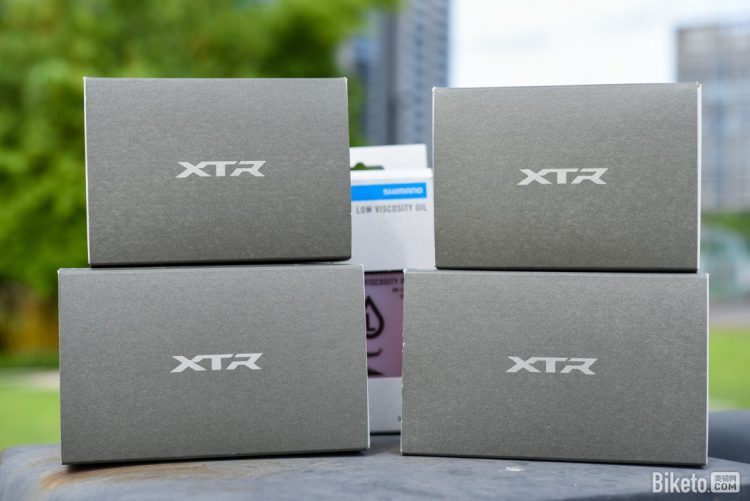
Final Verdict
Shimano addresses key points from the previous generation with the XTR M9220, delivering “precise ergonomics, powerful braking, and reliable stability.” These upgrades solidly boost the XTR series’ performance for Enduro riding, making the M9220 a top choice for advanced riders seeking durable, refined control. The industry will now watch for these core technologies to trickle down, allowing more riders to experience this level of stable and controllable braking performance.