
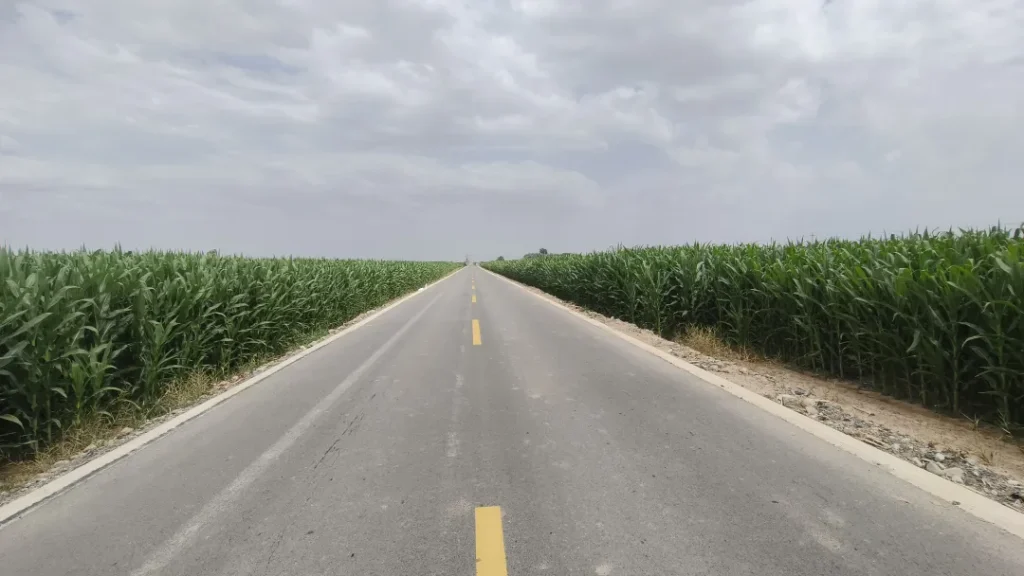

With immediate tasks complete and only life’s longer journeys left to pursue, I found myself with a day and a half of open time. I decided to fill it simply: by bicycle, heading out toward places I had never been, to observe scenes and lives unfamiliar to my own.
I. Expanses
Setting out from Jiuquan, the road ahead cut straight through vast stretches of Gobi and desert. In that immense and empty landscape, I felt as small as an ant. There is a certain clarity that comes with feeling insignificant—it puts your own life in perspective and reminds you that all living things share this space. So much worry stems from taking ourselves too seriously in crowded environments. When you feel this humble, the stakes of life and loss seem to soften.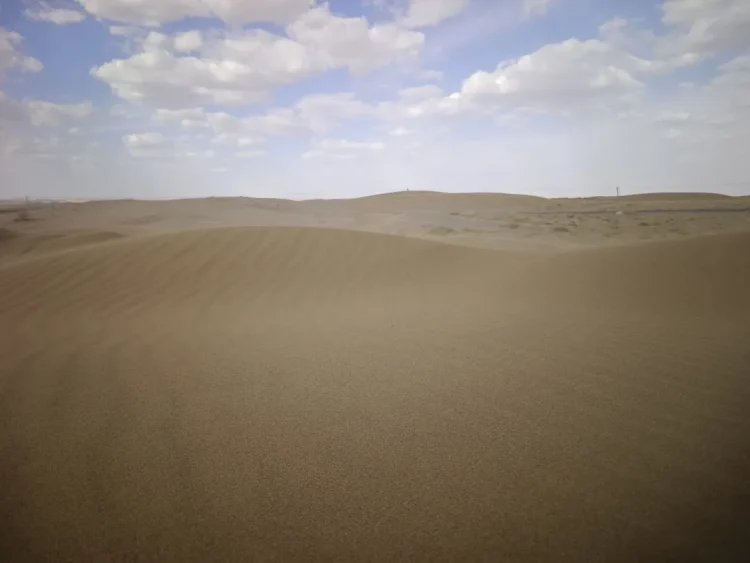
At times, the harsh terrain gave way to wetlands and farmland—sudden stretches of green, rich with blooming flowers.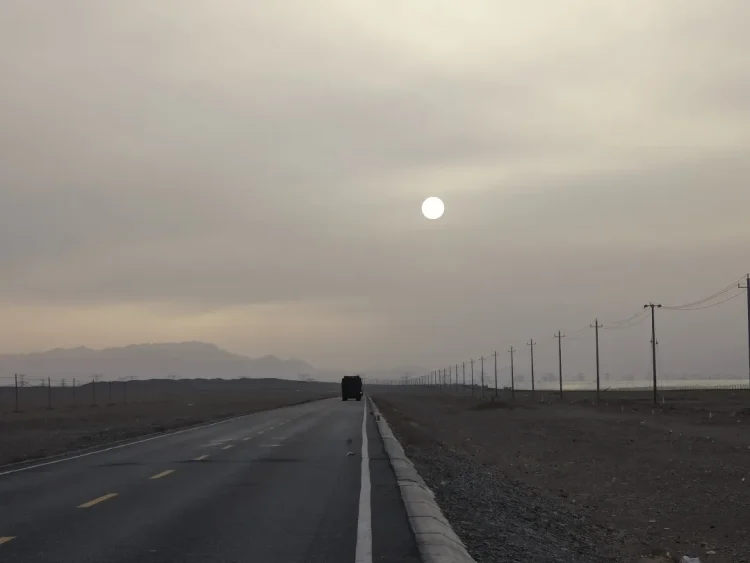
I also cycled through abandoned villages, quiet and brittle like cicada shells left in autumn. They decayed slowly in the silence, their chimneys—now cold—resembling mouths that wished to speak. Faded iron gates remained locked, guarding a family’s final secrets, while wild grasses slowly reclaimed the land, burying memories of warmer days.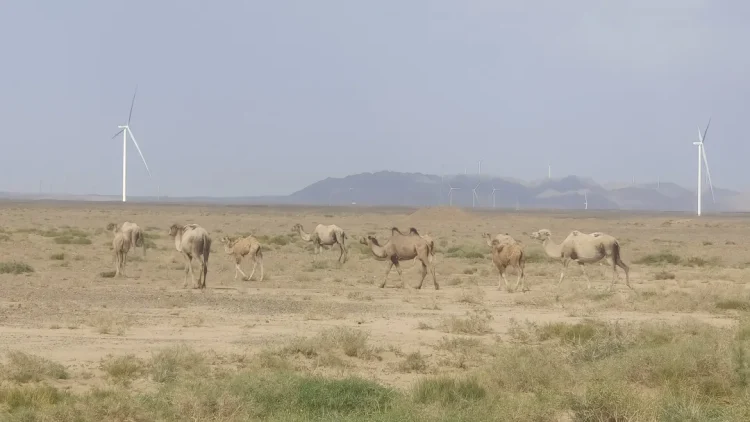
Not far off, newly built settlements stood in orderly rows—white walls, dark tiles—quiet and calm.
We surprised a group of wild camels at one point; they turned and hurried away. They wanted nothing to do with people—only to roam freely across the stark, open land.
II. Mingtangwan Reservoir
After more than two hours of riding, I spotted Mingtangwan Reservoir—a welcome sight. Lush reeds lined its banks, though the water level was low; marks along the shore showed it had receded more than two meters.
A man from a nearby house came out and spoke with us. “It’s been dry these past few years,” he said. “There’s less water each season.”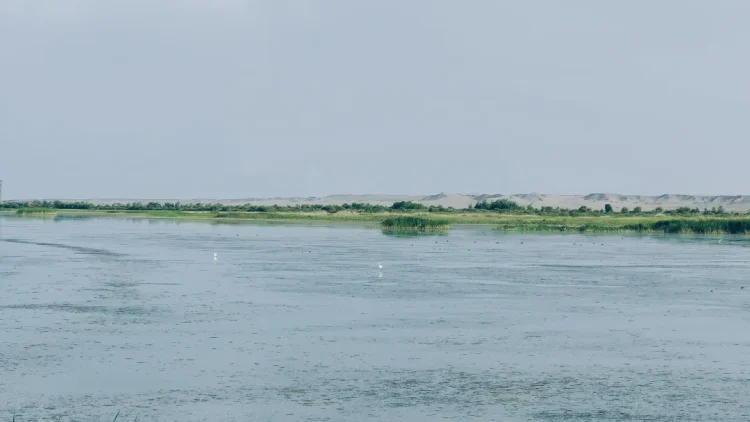
Birds filled the reeds and trees with a near-constant chorus of calls. My companion, Y, found the noise distracting and tossed a small stone into the reeds. The birds went quiet for only a moment before resuming their songs. “Let them sing,” I said. “A place like this needs the sound.” Y replied, “What this place needs is a soft rain and a mist over the water.” Y has a poetic way of seeing things.
A small group of white waterbirds drifted on the surface. We wondered if they were swans, but the local man corrected us—they were white storks. “Swans did come,” he added, “but they left in April.”
III. Zhengyi Gorge
We reached Zhengyi Gorge, our destination. Despite its name, the surrounding hills were not particularly high or steep—only bare, sunbaked slopes. But the Heihe River flowing below was wide and stately, moving with a quiet grace.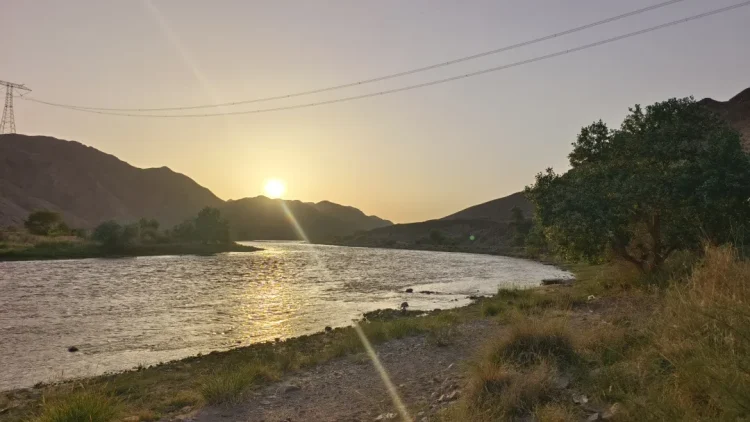
Zhengyi Gorge lies in Tiancheng Village—a small, seldom-visited place that still bears marks of a layered past. A memorial arch, sections of crumbling wall, and ancient beacon towers dot the hills.
The name “Zhengyi” was originally “Zhenyi,” meaning “subdue the barbarians.” Located where Jinta County, Inner Mongolia’s Ejin Banner, and Gaotai meet, this area was once a strategic passage and military stronghold, nicknamed “The Key to Tiancheng.” Though the name later changed, the local pronunciation remains close to the original.
During the Han dynasty, General Huo Qubiting stationed troops here. Later, the commander Zhao Tong fought the Xiongnu for seven days and nights nearby. After his death, locals erected a stone tablet beside a well he dug—a tribute still remembered.
By the Ming dynasty, a garrison was built here, staffed with over a thousand soldiers. Walls were raised, beacon towers erected. But as dynasties shifted, the site’s military role faded. By the late Qing, only a small guard remained.
Today, little is left—broken walls, silent beacon towers—all that speaks of time’s passage and the flow of history.
IV. A Restless Night
We pitched a tent in a parking area. After eating, we watched a golden full moon rise above the eastern hills.
We had hoped to rest under the moonlight, but mosquitoes arrived almost as soon as we sat down. We covered ourselves, but not before we’d collected a few itchy bites. “They must be desperate,” Y noted—they didn’t seem to mind the smell.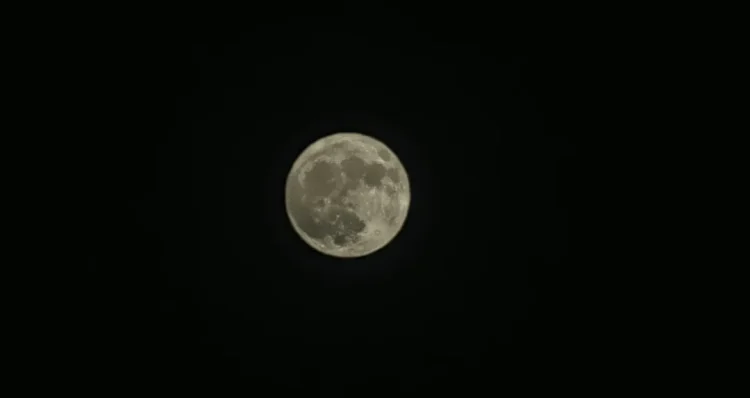
It was warm inside the tent. We felt pleased to have found such a level spot. But not long after we lay down, the wind picked up, shaking the tent fiercely. We hadn’t staked it down earlier, but as the walls pressed inward, we had no choice but to go out and secure it. By the time we finished, the wind had calmed.
Later, a stronger gust woke us—the tent flapping loudly. A good night’s sleep was not to be.
V. The Return
On our way back, we passed through Huaqiangzi Village. Y reminded me: this is where they filmed Return to Dust.
We cycled slowly through the lanes. It looked like many other villages—a mix of old and new houses, an elderly man sitting against a wall, a woman in a doorway, a young woman in modern clothes walking without hurry.
Yet within that ordinary calm, lives like Old Fourth’s unfold—quietly, almost invisibly. It is the power of film, perhaps, to pull such lives from the background and ask us to look closer. To help us feel, for a moment, the weight and dignity of a story seldom told.


