

Leading Brands Step Up Sustainability Efforts
Major bicycle manufacturers are intensifying their environmental initiatives, with decarbonization and circular economy strategies becoming central to their business models. Here’s how industry leaders are progressing:
 Decathlon: Driving Whole-Value-Chain Transformation
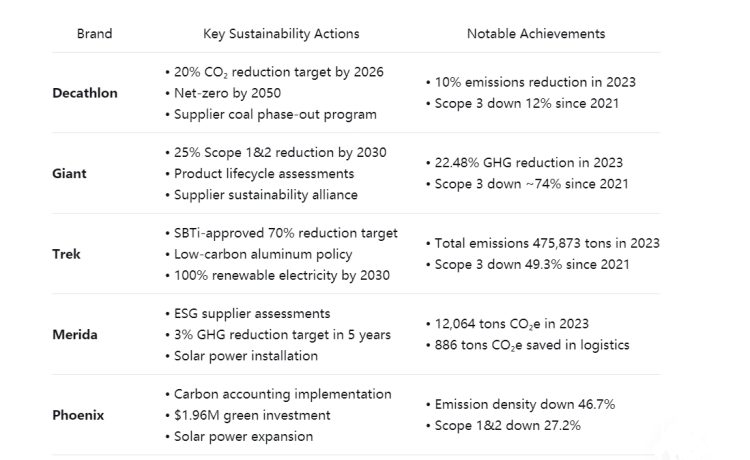
The sports retail giant has made sustainability a core global strategy, focusing on circular business models and eco-designed products. Their 2023 achievements demonstrate that business growth can be decoupled from emissions increases.
The brand’s eco-designed mountain bike, launched globally in 2022, reduces carbon emissions by 10% across its entire lifecycle through optimized materials, powder coating processes, and structural weight reduction.
With 74.8% of emissions coming from raw material extraction and production, Decathlon is pushing suppliers to transition from coal to renewable energy, targeting complete green energy adoption among key suppliers by 2026.
Giant: Building Industry-Wide Sustainability Alliance
Through its parent company Giant Group, the brand has established the Bicycling Alliance for Sustainability (BAS), uniting 75 suppliers in collective carbon reduction efforts. Over 80% of members have completed greenhouse gas inventories.
Giant has transparently disclosed product carbon footprints for two models – Stance 29 (159 kg CO₂e) and TCR Advanced Pro 0 (274 kg CO₂e) – with third-party verification. The company plans to expand carbon footprint labeling across its product range.
Since 2009, Giant’s travel services have hosted approximately 92,000 cyclists, reducing an estimated 585 tons of carbon emissions by replacing car travel with bicycle tours.
Trek: Ambitious Science-Based Targets Delivering Results
Trek’s SBTi-approved climate goals include a 70% reduction in Scope 1 and 2 emissions by 2033 and a 32.5% reduction in Scope 3 emissions. Their 2024 Sustainability Report shows significant progress, with total emissions dropping to 475,873 tons CO₂ in 2023.
The company’s innovative low-carbon aluminum procurement policy requires suppliers to use renewable energy, cutting aluminum-related emissions to just one-quarter of previous levels. The Marlin 5 model, built with this material, shows a 46% reduction in emissions.
Market Recovery and Premiumization Trends
China’s bicycle exports grew 20.89% year-over-year from January to October 2024, signaling market recovery. The premium segment shows particular strength, with 70.77% of cyclists willing to spend over $1,100 on high-end bikes – up from 63.36% in 2023.
Research indicates bicycles are becoming central to low-carbon urban mobility, with approximately 43% of residents using two-wheeled transportation for daily “15-minute neighborhood” trips. National daily carbon reduction from bicycle use equals the carbon sequestration of 550,000 trees.
As the industry evolves, brands that successfully integrate sustainability with premium product strategies appear positioned to lead the next phase of market growth.


