
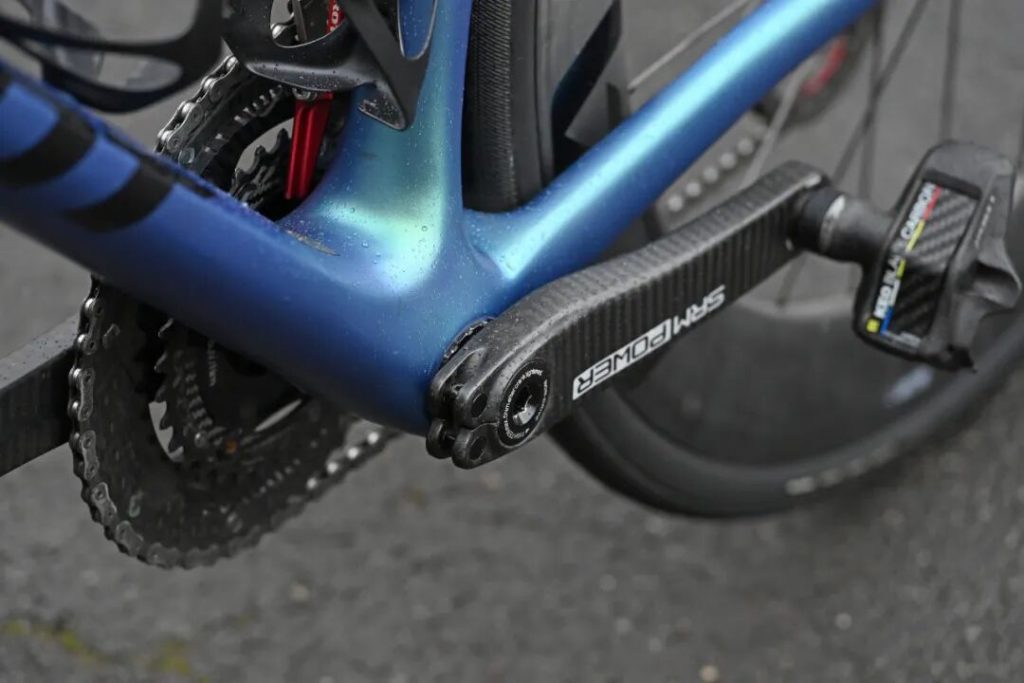

Are you experiencing hip, knee, or back pain while cycling? The culprit might be longer than you think—your crank arms. While many riders never give crank length a second thought, this often-overlooked component can make or break your comfort, efficiency, and speed.
Let’s break down how to find your ideal crank length—without overcomplicating it.

Why Crank Length Matters More Than You Think
It’s a common myth: longer cranks = more power.
But science says otherwise.
Research shows that power comes from a combination of torque and cadence. While longer cranks increase leverage, they often force a slower cadence—canceling out any real power gain.
What really changes? Your biomechanics.
Longer cranks increase knee and hip flexion, which can lead to:
Knee pain
Hip compression
Lower back strain
Reduced pedal clearance (especially on MTB)
Shorter cranks, on the other hand, help you spin faster, reduce joint stress, and improve aerodynamics—all without sacrificing power.
 How to Calculate Your Ideal Crank Length
While there’s no universal “perfect” length, these methods can help you find your sweet spot:
1. The Inseam Ratio Method
A popular starting formula is:
Crank Length (mm) = Inseam (cm) × 1.25
Example: If your inseam is 80cm → 80 × 1.25 = 100mm (suggesting a crank around 170mm as a baseline).
2. The 20% Rule
Some fitters recommend your crank length be roughly 20% of your leg length.
Measure from the floor to your hip bone, then multiply by 0.20.
3. The “Appleman Approach”
Custom frame builder Matt Appleman suggests most riders are actually better suited to cranks between 155–165mm—shorter than the industry standard.
He argues that very few riders truly need 175mm cranks, even if they’re tall.
A Simpler Way: Listen to Your Body
You don’t always need a formula. Ask yourself:
Do my knees hit my chest at the top of the pedal stroke?
Do I struggle to spin above 85 RPM?
Do I experience hip or knee pain after riding?
If you answered yes, try a shorter crank.
Quick Reference Guide:
Riders under 165cm → 165–170mm
Riders 165–180cm → 170–172.5mm
Riders over 180cm → 172.5–175mm
But remember: these are starting points, not rules.
The Case for Shorter Cranks
More riders—including pros—are downsizing. Here’s why:
Better Aerodynamics: Shorter cranks let you ride lower and tighter without closing your hip angle.
Higher Cadence: Easier to spin efficiently at 90–100 RPM.
Fewer Pedal Strikes: Essential for mountain bikers and crit racers.
Less Joint Stress: Ideal for riders with limited flexibility or past injuries.
Even Tour de France winner Bradley Wiggins switched to 170mm cranks (despite being 190cm tall) for his Hour Record attempt—purely for aero gains.
Final Tip: Test Before You Invest
Switching crank length isn’t cheap. If you’re unsure:
Try a friend’s bike with shorter/longer cranks.
Visit a bike fitter for a dynamic assessment.
Change in small increments (5mm is a good start).
There may not be one “perfect” crank length—but there’s definitely a wrong one. When in doubt, go shorter. Your knees (and your speed) will thank you.
Ready to optimize your ride? Start with your crank length—it’s the small change that can lead to big gains.


